Welcome to my 7th grade science blog!

Wednesday, March 16, 2011

Summaries About Sections I Took Notes On


Section Summaries
Section 1:
In this section we learned various things about sound and how it works. Similar to what we learned in the Bill Nye video, “Sound is a disturbance that travels through a medium as a longitudinal wave”. I found it interesting that all sounds need vibration, and vibration needs a medium, so in empty space where there is no air, sound just doesn’t exist. I knew that sound couldn’t exist before, but I never knew why. I also learned about various properties of the medium that sound can travel through that affect the way sound travels, like the elasticity, density and temperature of the medium. The section ended with a brief history and explanation of supersonic travel.
Section 2:
In the previous section one of the things I learned about was the properties of the medium sound travels through. In this section, I learned about properties of sound itself. Those properties include intensity, loudness, frequency, pitch and resonance. The section continued with an explanation of the Doppler effect, and ended with a brief explanation about how the sound barrier for supersonic planes work.

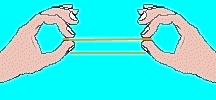
Rubber Band Sounds


This is the second lab that I'm posting.

Rubber Band Sounds

I.  GUIDING QUESTION: How are the sounds that vibrating rubber brands produce effected by their width, their stretch, their length and how far out they are stretched?


II. HYPOTHESIS:
I think that the more the thinner, more stretched, shorter, or more stretched out to the side a rubber band is, the higher it will sound.


III.  Exploration (PLAN & DO A TEST):

Materials:
  • Thin Rubber Band
  • Thick Rubber Band


Procedure:
  1. Stretch out a rubber band.
  2. Pull and let go off the rubber band, leaving it to vibrate
  3. Repeat steps 1 and 2 using different amounts of stretching, stretching to to the side, or change the length or width of the rubber band.


IV.  RECORD & ANALYZE:
Amount of Side-StretchObservations
1 centimeterlow, almost no sound
2 centimeters sound is higher and longer than with 1cm
3 centimeterssound is higher and longer than with 2cm
4 centimeterssound is higher and longer than with 3cm
5 centimeterssound is higher and longer than with 4cm

Amount of Length-StretchObservations
Lowa very low, unclear sound
Higha rather high pitch, slightly unclear sound

Thickness of Rubber BandObervations
Thicka very low, very unclear sound
Thina relatively low, unclear sound

Length of Rubber BandObservations
Shorta rather high pitch, clear sound
Mediuma lower pitch and more unclear than the “Short” one
Longthe lowest pitch and unclearest sound of the three


V.  Concept Acquisition (CONCLUSION):  
Our Guiding Question was “How are the sounds that vibrating rubber brands produce effected by their width, their stretch, their length and how far out they are stretched?”. To this I answered, “I think that the more the thinner, more stretched, shorter, or more stretched out to the side a rubber band is, the higher it will sound.” I believe that my hypothesis was right as our results clearly show answers that match my expectations. This is probably because when the waves travel through a looser or shorter rubber bands, their frequency and therefore even their “pitch” lowers. For the side stretching part, I believe that we acquired our answers thanks to the larger stretch increasing the amplitude of the waves and therefore making the sound more audible.


VI.  Concept Application (FURTHER INQUIRY):
The stretching of the rubber bands was done by hand so we cannot rely on its accuracy. If we used something more accurate than human labour, we could get more accurate results. I still believe that the general results would remain the same. Also, we could do tests with material other than rubber bands to see if the results would remain the same or if they would change with the change of material. Overall I think that this was a “simple” lab and the general idea seems to be more important than exact results. For exact results, the tests would have to have been conducted differently.

How People Produce Sound


While we had a substitute, we did two labs. My parter was Jan. I finished these labs a while ago in Google Docs, but I haven't posted them until now.

How People Produce Sound


I.  Guiding Objective:
Objective 1: Observe how your vocal cords affect the sounds you make.
Objective 2: Observe how you lips, tongue, and teeth influence the sounds you make.

II.HYPOTHESIS:  I think that tighter and longer vocal cords will make higher sounds. I also this that the lips, tongue and teeth are vital tools that your body uses to produce different sounds.

III.  Exploration (PLAN & DO A TEST):
         (Materials) List the instruments and materials you will use
       Procedure - Requires partner
  1. Pronounce the Words in the list below to your partner. Pay attention to how you pronounce the first letter in each word.
  2. Together decide if you are stopping your breath when you are pronouncing the first letter of each word. Use a check mark to record in the Data section if the consonant is stopped or open.

Word List:
boat
fan
kite
pen
sister
dog
vote
gate
zebra
tone


IV.  RECORD & ANALYZE
         Data Tables:
                      
First Letter
Stopped
Open
b
✓
f
✓
k
✓
p
✓
s
✓
d
✓
v
✓
g
✓
z
✓
t
✓

       
          Analysis of Data: I determined whether our vocal cords were open when I pronounced specific letters by feeling with a hand whether considerable air flowed out of the mouth when the letter was pronounced. My partner and I both pronounced the letters, and almost always agreed whether our vocal cords were open or closed. I don’t really see any patterns in this data, because all of these letters are consonants yet some require open vocal cords, and some require closed.


IV.  Concept Acquisition (CONCLUSION):  
1. Is the shape of your mouth or the position of your teeth or tongue different when you pronounce a “d” than when you pronounce a “t”? No, my tongue and teeth positions are the same when pronouncing those letters.
2. What is the difference between the sound of a “d” and the sound of a “v”? When making a “d” sound, my tongue touches the roof of my mouth. When I make a “v” sound, my lower lip touches my upper set of teeth.
3. For which first letter sound(s) in the table do you use you lips and your voice, but not your tongue or teeth? I don’t use my tongue or teeth when making “b”,  and “p” sounds.
4. What part of the larynx is like the strings of a guitar?  The vocal cords are like the strings of a guitar.

My guiding objectives were:
“Objective 1: Observe how your vocal cords affect the sounds you make.
Objective 2: Observe how you lips, tongue, and teeth influence the sounds you make.”
In my tests I learned that the tighter the vocal cords are, the higher pitched sound the make. I also learned that my body uses my lips, tongue and teeth to manipulate my mouth in various ways so that it can produce a wide variety of sounds. This is quite similar to what I said in my hypothesis, so I was correct.

V.  Concept Application (FURTHER INQUIRY):   
I think that my data is quite valid, mostly because the tests I conducted were simple and there wasn’t really a large potential for error. I don’t think that I need any improvement in this category. If I were to do this again, I would test a wider variety of letters so I would have a better chance to look for patterns.
Why are women’s voices usually of a higher pitch than men’s? I think that women have higher-pitched voices than men because their vocal cords are more stretched.
Why, then, are the voices of young girls and boys about the same pitch?
Their voices are about equal because before puberty, their vocal cords are stretched about the same amount.

Tuesday, March 1, 2011

Earthquake Safety

     As a new science assignment about earthquakes, I am supposed to write about how I would prepare my apartment for an earthquake.


Before the earthquake, I would make a survival kit containing this list of items that I got from this website.

  • Flashlights with extra batteries
  • Battery-powered radio with extra batteries
  • One-week supply of water
  • One-week supply of non-perishable food and a manual can opener
  • Alternative cooking source
  • A first aid kit and handbook
  • A-B-C multipurpose fire extinguisher
  • Extra medication for those who need prescription drugs
  • Adjustable pipe or crescent wrench to turn off the gas and water supply
  • Chlorine bleach and instructions for purifying water
  • Candles and matches
  • Blankets, warm clothes, sturdy shoes and heavy glove
Preparation: 
I  would have a professional come and inspect all the appliances in our home, to make sure they are earthquake ready. If I have a gas stove, I should know where the shutoff switch is, but I have an electric stove, so I don't need to do that. However, everyone should know where the electric switchoff is. Also, we have a lot of unsecured bookshelves with lots of books and other heavy things on them, so I would secure them with brackets, like this:


While the Earthquake Happens:
Stay indoors if you already are. Get under a sturdy table or desk, or go in a doorway.

 You shouldn't hide near walls that connect outdoors. Also avoid mirrors, picture frames, glass and furniture that might tip over. IF you are outdoors, stay away from power lines and buildings. For example, a parking lot would be ideal. In my house, I would probably go to the archway in my living room, because it is away from glass and furniture that might tip over.

Evaluating my House for Earthquake Safety
My house isn't so earthquake safe, because there is a lot of glass. We have glass doors, lots and lots of windows, and not that many tables or desks. However it doesn't have a gas stove, and we have lots of doorways, so that's a plus.

Monday, February 28, 2011

One of my recent assignments was to write a report in essay format about tsunamis and tsunami detection.

Adrian 7A
Due March 1st
Early Warning: Tsunamis
            In 2004, a giant wave hit 14 countries including Indonesia, Sri Lanka India, Thailand and many more. In Sri Lanka alone, it destroyed 100,000 homes and demolished two thirds of the fishing fleet. What was this “giant wave,” and what caused it? Is there anything that can be done to prevent them? In this report I will cover three different branches of the topic of “giant waves”: what they are, how they are detected, and some notable or historical ones.
            The giant wave that I described in the first paragraph was a tsunami. The word tsunami is defined by Princeton.edu as “a destructive sea wave caused by an earthquake or volcanic eruption”. In other words, a tsunami is a large, powerful wave that was created by an undersea earthquake or volcanic eruption. They can also be caused by landslides and even explosions from undersea bomb tests. More specifically, the waves are created when lots of water is displaced because of the earthquake, volcanic eruption etc. For example, during an earthquake a tectonic plate can “flip up” because of pressure from another tectonic plate. However, when it “flips up”, it displaces, or moves a lot of water out of the way. The water is moved at great force, which forms the tsunami. One interesting fact is that tsunamis start out with a very long wavelength and short amplitude, which means that they are hard to detect visually out at sea and are long and flat. However, as they move closer to shore their wavelength decreases and the amplitude increases, which makes the waves taller and easily detectable.

Because tsunamis are caused by nature instead of humans (except for explosions), they are not preventable. However, they are somewhat detectable, so humans can get an early warning and escape the tsunami. One method that is used to detect tsunamis is through the use of seismic gauges which detect the earthquakes that can cause tsunamis. However, not all earthquakes lead to a tsunami, which means that a seismic gauge’s readings wouldn’t always be useful. To predict a tsunami, there are two general types of detectors that are the most used. “Pressure recorders,” which detect the weight of all the water above it, and “tide gauges”, which are measure the height of the sea level from the sea floor as well as other conditions. The pressure recorders look for a dramatic increase in total weight of the water above it. If a large increase is detected, it probably means that there is a tsunami above it. The tide gauges have an extremely long cable attached to the seafloor, all the way up to the buoy. The cable is used to detect the distance of the sea level from the sea floor. When there is a large increase, it means there is probably a tsunami. In that way, the two devices are similar. Both of these devices are used to detect a tsunami from far out, where the tsunami is difficult to detect. As a tsunami approaches the coast, it “sucks in” the water from the coast (in other words, the water will retreat), so a tsunami is easily detectible then, although it is at the last minute. As a final word, there is no guaranteed-to-work method of detecting tsunamis, and so tsunamis will continue to be a problem in the foreseeable future.
The most famous tsunami in history is surely the 2004 tsunami in Southern Asia which was mentioned in the first paragraph. It killed more than 150,000 people, but more than $7 billion dollars were pledged to be donated. Interestingly, a BBC article from 2005, a year later, stated that there was a shortfall of over $4 billion of the money that was pledged to be donated. The earthquake that caused the tsunami was 9.1 on the Richter scale, which makes it the third largest earthquake ever recorded, behind earthquakes in Chile and Alaska. Another notable tsunami was the 1999 Tsunami in Turkey, which was caused by a 7.6 level earthquake, and killed 17,000 people.

An additional notable tsunami was the 2006 tsunami in island of Java. This tsunami only claimed 500 lives, which is small compared to other tsunamis, but it was significant because it took place a year and a half after the tsunami in Southern Asia, yet it was not detected early enough to give the residents of Java time to evacuate. This showed the failure of the network of tsunami detectors that was built after the 2004 tsunami. Since then, more pressure sensors, seismological stations and other tsunami detecting hardware have been built.
To conclude, tsunamis are interesting but unfortunate natural disasters. They are often difficult to detect, and they have the power to kill thousands of people, as evidenced by the 2004 earthquake in Asia. They are out of our power like any other natural disaster, but with developing technology, our ability to detect them has gotten much better. Although it won’t come soon, maybe someday we’ll live in a world where tsunamis are detected days ahead of their arrival, and they won’t kill people anymore because all people would have been evacuated.


Sources:
2005, February. "2004 Indian Ocean Earthquake and Tsunami." Wikipedia, the Free Encyclopedia. Web. 28 Feb. 2011. .
BBC. "BBC NEWS | Asia-Pacific | Tsunami Aid Shortfall over $4bn." BBC News - Home. 18 Mar. 2005. Web. 28 Feb. 2011. .
Princeton. "Definition of Tsunami." World Net Web from Princeton. Web. 28 Feb. 2011. .
Columbia Encyclopedia. "Tsunami - Credo Reference Topic." Credo Reference Home. Web. 28 Feb. 2011. .
"Famous Tsunamis · Mega Tsunamis." Astrology Weekly - Astrology Articles and Information Updated Weekly. Web. 28 Feb. 2011. .
"BBC NEWS | Science/Nature | Indian Ocean Tsunami Warning System." BBC News - Home. 23 Dec. 2005. Web. 28 Feb. 2011. .
Smith-Spark, Laura. "BBC NEWS | Asia-Pacific | Indonesia Tsunami System 'not Ready'" BBC News - Home. 19 July 2006. Web. 28 Feb. 2011. .
"BBC NEWS | Asia-Pacific | Tsunami Aid: Who's Giving What." BBC News - Home. 27 Jan. 2005. Web. 28 Feb. 2011. .


Side note: I think my fingers are tired of typing T's before S's now. It feels so unnatural.